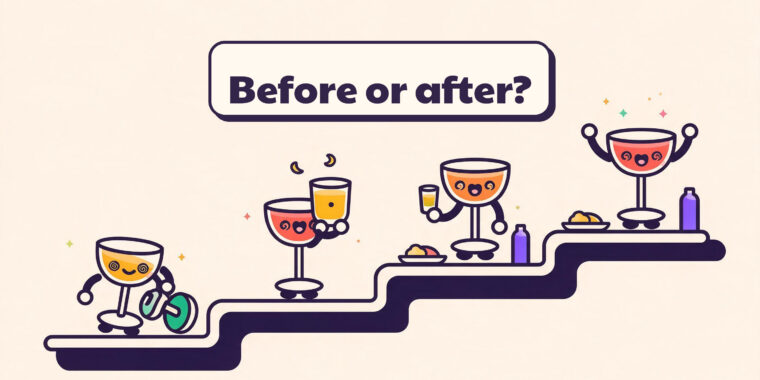
Let’s start with the honest answer: neither is good. Alcohol before or after exercise both undermine what you’re trying to achieve. But life isn’t lived in a lab, and sometimes you’re going to have a drink near a workout. The question is: which direction does less damage?
The answer isn’t what most people assume.
Drinking Before a Workout: The Case Against It
Drinking before exercise is the worse option. Here’s why, layer by layer.
Coordination goes first. Alcohol depresses your central nervous system. Fine motor control, balance, and reaction time all degrade — measurably, even at low doses. A 2012 study in the Journal of Science and Medicine in Sport found that a blood alcohol concentration of just 0.04% (roughly two standard drinks) significantly impaired balance and motor coordination. Under a barbell. On a treadmill. Holding a kettlebell above your head. You see the problem.
Injury risk spikes. Impaired coordination plus fatigue plus heavy loads equals a dramatically higher chance of something going wrong. It’s not just catastrophic injuries either — it’s the subtle form breakdowns that accumulate over weeks. A slightly rounded lower back on a deadlift. A knee that drifts inward on a squat. You get away with it once. Twice. The third time, something pops.
Dehydration accelerates. Alcohol is a diuretic. Exercise makes you sweat. Combine both, and you’re losing fluid from two directions simultaneously. Dehydrated muscles produce less force. Dehydrated joints have less lubrication. Dehydrated brains make worse decisions about whether that fifth set is really a good idea.
Your heart rate goes haywire. Alcohol increases resting heart rate while simultaneously reducing heart rate variability — your body’s ability to adapt to changing demands. Then you add exercise, which also elevates heart rate. Your cardiovascular system is getting conflicting instructions, and neither of them is “perform optimally.”
Thermoregulation breaks. Alcohol dilates blood vessels near the skin, making you feel warm while your core temperature drops. Exercise generates internal heat. Your body’s temperature control system gets confused, which means you’ll fatigue faster — especially in hot or cold environments.
Bottom line: drinking before a workout is like driving with the parking brake on. You might get somewhere, but you’re damaging the vehicle and it’s going to cost you.

Drinking After a Workout: Less Dangerous, Still Damaging
Post-workout drinking is the lesser evil, but “lesser” is doing a lot of work in that sentence.
You waste the anabolic window. The period immediately after training is when your muscles are most receptive to nutrients. Blood flow is elevated. Insulin sensitivity is high. Amino acid transporters are upregulated. Your body is primed to repair and rebuild. Alcohol slams the door on this window. It reduces mTOR signaling, impairs glucose uptake into muscles, and interferes with the phosphorylation cascade that triggers protein synthesis. You trained hard to open a window, then immediately boarded it up.
Recovery time extends significantly. A study in the European Journal of Applied Physiology found that post-exercise alcohol consumption delayed recovery of maximal strength by up to 48 hours. Your muscles aren’t just not growing — they’re staying damaged longer. The soreness you feel three days after drinking post-leg-day isn’t just the workout. It’s the alcohol.
Glycogen replenishment stalls. After training, your muscles are desperate to refill their glycogen stores. Alcohol interferes with this process by reducing the activity of glycogen synthase — the enzyme responsible for converting glucose into stored glycogen. You’re leaving your tank half-empty for tomorrow’s session.
Inflammation compounds. Exercise causes acute inflammation — that’s the stimulus for adaptation. Alcohol also causes systemic inflammation. Combine the two, and your body is fighting a two-front war. Recovery resources get diverted to managing alcohol-induced inflammation instead of repairing training-induced muscle damage.
If You Must: Damage Control Strategies
Nobody’s perfect. If you’re going to drink around your training, here’s how to minimize the damage:
If you must drink before training (please don’t):
- Limit yourself to one standard drink, at least 90 minutes before you train
- Drink 500ml of water per alcoholic drink
- Eat a full meal with protein and complex carbs before the session
- Lower your training intensity — this is a maintenance session, not a progression session
- Skip compound lifts. Seriously. Machines only. Nothing above your head or spine
If you’re drinking after training:
- Wait at least 60 minutes after your workout before drinking. Use that hour to eat a proper post-workout meal with 30-40g of protein and quality carbohydrates
- Hydrate aggressively — aim for 750ml of water with electrolytes before your first alcoholic drink
- Stick to lower-alcohol options. A 5% beer is better than a 9% IPA. A single spirit with soda is better than a cocktail
- The three-hour rule applies doubly here: finish your last drink at least three hours before bed
- The next day is a rest day. Don’t plan heavy training within 24 hours of drinking
The Timing Hierarchy, Ranked
From best to worst:
- No alcohol near training — optimal, but we’re not robots
- Post-workout, with food and water, hours before bed — the least damaging real-world option
- Post-workout, late at night, skipping food — you’re losing gains and sleep
- Pre-workout, any amount — just don’t
The gap between option 2 and option 4 is enormous. One is a manageable trade-off. The other is self-sabotage dressed up as multitasking.
What the Data Says If You Track It
This is where tracking becomes genuinely useful. In Soberya, log not just what you drank but when — relative to your workouts. Add notes about how the next session felt.
After a month, filter your data. Look at the workouts that followed drinking within 12 hours. Compare the numbers — reps, weight, energy rating — against your dry-day workouts. I’ve done this. The difference is not subtle.
You don’t need to take my word for it, or any study’s word. Your own data will tell you exactly how much alcohol near training costs you. And once you know the price, you can decide whether it’s worth paying.
Sometimes it is. A friend’s wedding toast. A post-marathon beer. These are moments, not mistakes. But a random Tuesday happy hour before chest day? That’s not a moment. That’s just bad planning.