You’ve been grinding. Four sessions a week. Progressive overload. Protein shakes that taste like regret. You’re doing everything right — except for Friday night. And Saturday night. And that one “harmless” beer after Wednesday’s leg day.
Here’s the thing no one tells you in the gym: alcohol doesn’t just pause your progress. It actively erases it. That six-pack you’re chasing? It’s drowning in a six-pack.
Let’s look at what’s actually happening inside your body every time you drink — because it’s worse than most people realize.
The Muscle Protein Synthesis Problem
Muscle growth happens through a process called muscle protein synthesis (MPS). You lift heavy things, you create micro-tears in muscle fibers, and MPS repairs them — bigger and stronger than before. That’s the whole game.
Alcohol throws a wrench directly into this machinery.
A study published in the Journal of Strength and Conditioning Research found that alcohol consumption after exercise reduces MPS by up to 37%. Not 5%. Not 10%. Thirty-seven percent. Even if you eat enough protein. Even if your training was perfect.
The mechanism is straightforward: alcohol inhibits mTOR signaling — the primary pathway your body uses to trigger muscle repair. You’re literally telling your muscles, “Don’t bother fixing that damage.” After a heavy workout. After paying for that gym membership.

Testosterone Down, Cortisol Up
If MPS is the engine of muscle growth, testosterone is the fuel. And alcohol is a fire extinguisher aimed directly at it.
A single bout of heavy drinking can reduce testosterone levels by 23% for up to 24 hours. Chronic drinking keeps testosterone chronically suppressed. Lower testosterone means less muscle growth, slower recovery, and — for the vanity-minded — less of that lean, vascular look you’re working for.
Meanwhile, alcohol spikes cortisol. Cortisol is a catabolic hormone — it breaks down muscle tissue for energy. So you’ve got less testosterone telling your body to build muscle, and more cortisol telling it to tear muscle down. You’re running uphill. Backwards. In flip-flops.
Dehydration: The Silent Gain Killer
Muscle tissue is roughly 75% water. Dehydration reduces muscle volume, decreases strength output, and slows nutrient transport to damaged tissues.
Alcohol is a diuretic. It suppresses vasopressin — the antidiuretic hormone that tells your kidneys to retain water. For every gram of alcohol you consume, your body excretes roughly 10 milliliters of extra urine. A night out can leave you significantly dehydrated before you even notice.
Dehydrated muscles don’t contract as forcefully. Dehydrated connective tissue is more prone to injury. And dehydrated cells can’t efficiently shuttle amino acids where they’re needed for repair. You’re not just hungover — you’re physically incapable of performing at your best.
Sleep: Where the Real Damage Happens
Muscle repair doesn’t happen in the gym. It happens while you sleep. Deep sleep triggers growth hormone release — the most powerful muscle-building signal your body produces. REM sleep consolidates motor learning, which is how your nervous system gets better at the movements you practiced.
Alcohol destroys both.
We covered this in detail in our article on alcohol and sleep, but here’s the fitness-specific version: alcohol fragments your sleep architecture, suppressing REM and disrupting the deep-sleep cycles where growth hormone peaks. You might have “slept” eight hours, but you got maybe four hours of actual restorative rest. That’s four hours your muscles spent not repairing. Four hours of gains you’ll never get back.
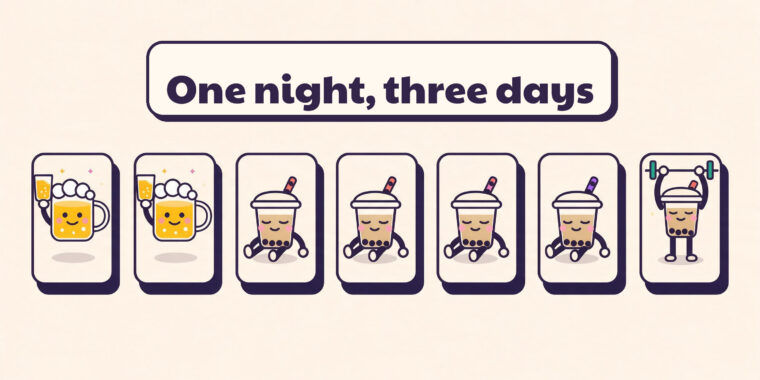
The “One Night Out = Three Days Lost” Math
Here’s the brutal equation:
Day 1 (Drinking day): You go out. MPS drops 37%. Cortisol spikes. Your body stops burning fat for fuel because it’s busy processing alcohol.
Day 2 (Hungover day): You’re dehydrated, sleep-deprived, and your testosterone is still suppressed. Even if you drag yourself to the gym, your output is garbage. You’re not building muscle — you’re just going through the motions.
Day 3 (Recovery day): Your hormones are normalizing, but you’re still catching up on sleep and hydration. MPS finally returns to baseline.
One night out. Three days of zero net progress. If you drink two nights a week, that’s six compromised days. You’re leaving yourself one good training day. One.

Empty Calories and the “Can’t Out-Train It” Reality
We’ve written about alcohol calories before, but the fitness angle deserves repeating: alcohol provides seven calories per gram — nearly twice the energy density of protein or carbs. These calories provide zero nutritional value. Zero amino acids. Zero glycogen replenishment. Just energy your body has to burn before it can touch fat stores.
Three IPAs is roughly 900 calories. That’s equivalent to an entire post-workout meal plus a protein shake — except without any of the nutrients your muscles need to recover from the workout you just did.
You cannot out-train a drinking habit. The treadmill is not impressed by your social life.
Track It and See the Pattern for Yourself
The gym bros will tell you to never drink. The wellness influencers will tell you alcohol is poison. Both are technically correct, and neither is particularly helpful for a normal person with a social life.
What actually works is seeing your own data. Start logging your drinks and your workouts in Soberya. After two weeks, filter your workout notes — look at the days after you drank. I guarantee you’ll see a pattern. Lower energy. Fewer reps. Longer recovery. Worse mood.
That correlation isn’t a coincidence. It’s biochemistry. And once you see it in your own numbers, you can make informed decisions about which nights are worth the trade-off and which aren’t.
The goal isn’t to become a monk. It’s to stop accidentally sabotaging work you’ve already done.