It starts quietly. You notice they pour a third glass when you’ve barely finished your first. They suggest another round and you realize you’ve been ready to go home for an hour. They wake up Saturday morning foggy and sluggish while you’re already lacing up your running shoes.
You’re not judging them. You’re not trying to control them. But something feels… off. And you’re not sure how to talk about it without it sounding like an accusation.
Welcome to one of the most common — and least discussed — dynamics in relationships: the drinking gap.
When the Gap Opens
Relationship researchers call it behavioral asymmetry — when partners develop different patterns around the same activity. Drinking is one of the most potent examples because alcohol doesn’t just change what you do. It changes how you are.
One partner has two drinks and gets chatty. The other has five and gets emotional. One wakes up refreshed and ready for a hike. The other cancels plans and orders greasy food. One remembers the conversation from last night. The other doesn’t.
These gaps compound. What starts as “you drink a bit more than me” gradually becomes:
- Different energy levels: Saturday mornings become a solo activity. You’re at the farmer’s market; they’re in bed.
- Different priorities: They want to plan weekends around breweries and wine tours. You want to plan around things that don’t revolve around drinking.
- Different emotional realities: You process your day with a walk or a conversation. They process theirs with a bottle opener.
- Resentment by accumulation: Not one big fight — just a thousand small moments where you felt alone in the relationship.
The worst part? Neither person is necessarily doing anything “wrong.” They’re just operating on different wavelengths — and those wavelengths are drifting further apart.

Why It’s So Hard to Talk About
Try saying “I think you drink too much” to your partner. Seriously, imagine the words leaving your mouth. Even if it’s true, even if it comes from a place of love, it lands like a grenade.
Here’s why: alcohol is tied to identity. When you criticize someone’s drinking, they don’t hear “I’m concerned about your health.” They hear “I think you’re losing control,” “I’m judging you,” or “I think you’re an alcoholic.” The shame response is immediate and it shuts down communication before it starts.
So most people say nothing. They let it simmer. They make passive-aggressive comments about “another one?” They feel the resentment grow and tell themselves they’re being patient. They’re not being patient. They’re avoiding a hard conversation — and the distance keeps widening.
How to Talk About It Without Starting a Fight
There is a way through this. It requires dropping the word “you” and picking up the word “we.”
1. Frame it as a shared observation, not a personal critique.
Instead of: “You’ve been drinking a lot lately.” Try: “I’ve noticed our evenings have been looking different lately. Can we talk about that?”
2. Talk about impact, not behavior.
Instead of: “You’re always hungover on Saturdays.” Try: “I miss our Saturday mornings together. I feel like I’m losing that time with you.”
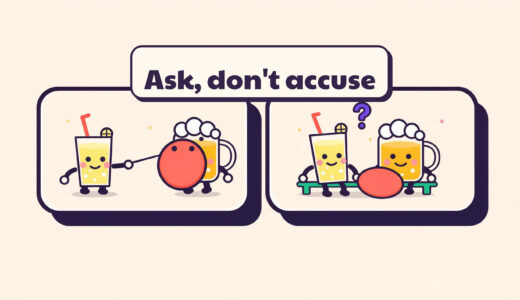
3. Ask, don’t accuse.
Instead of: “Why do you need to drink so much?” Try: “What does drinking do for you right now? I genuinely want to understand.”
4. Make it about the relationship, not the person.
Instead of: “You have a problem.” Try: “I feel like we’re drifting into different rhythms, and I don’t want that for us.”
The goal isn’t to win an argument. It’s to open a door that your partner might not even know was closed. Many people in this situation aren’t defensive because they’re in denial — they’re defensive because they’re ashamed, and they don’t know how to change.
Setting Boundaries Without Being Controlling
There’s a line between supporting a partner and enabling them. Knowing where that line sits is uncomfortable but necessary.
Boundaries aren’t ultimatums. An ultimatum is “stop drinking or I’m leaving.” A boundary is “I’m not going to stay at parties past midnight anymore, but I’d love for you to come home with me.”
Other examples of healthy boundaries:
- “I’m not going to pour your drinks for you. That’s yours to manage.”
- “I’ll do dry January with you if you want, but I’m not going to police your choices.”
- “If you’re too hungover for the plans we made, I’m still going — but I’ll be disappointed.”
- “I won’t lie to friends or family about how much you’re drinking.”
Boundaries protect your energy without trying to control theirs. They communicate: I love you, and I’m not going to drown with you.

Supporting a Partner Who Wants to Cut Back
If your partner acknowledges the gap and wants to close it, congratulations — you’re past the hardest part. Now the real work begins.
Supporting someone who’s cutting back is not about being the alcohol police. It’s about making the sober choice the easy choice.
Practical ways to help:
- Stock the fridge with great non-alcoholic options. Athletic Brewing, Seedlip, Ghia, or just fancy sparkling water with lime. Make the alternative appealing, not penitential.
- Suggest alcohol-free dates. Hiking, movies, early-morning coffee, cooking together — activities where drinking isn’t the default centerpiece.
- Match their pace. If they’re having one, you have one. If they’re having none, you have none. Solidarity is louder than any speech.
- Celebrate the wins. A week of hitting their goal? That deserves acknowledgment. Not a drink to celebrate — but a genuine “I see you doing this, and I’m proud of you.”
Tracking Together: Soberya for Couples
One of the most effective strategies couples use is tracking their drinking together. Not as a surveillance tool — as a shared project.
Soberya works brilliantly for couples. You can log your drinks, compare weekly patterns, set shared goals (or individual ones), and see the data side by side. It turns a sensitive topic into something collaborative: we’re doing this together, we’re tracking our progress, we’re in it as a team.
When both partners can see the numbers — the units, the calories, the money saved, the dry days racked up — the conversation shifts from “you have a problem” to “look at what we’re achieving.” That reframe alone can change everything.