I have a good job. I exercise four times a week. I eat well — mostly plants, lean protein, the whole Mediterranean diet thing. I’m a present parent, a reliable friend, a productive member of society. On paper, I’m doing great.
I also used to drink 3–5 drinks every single night.
These two statements lived comfortably together in my head for years. The drinking didn’t undermine the success, I told myself. The success proved the drinking wasn’t a problem. Circular logic, perfectly self-sealing. I was the poster child for the high-functioning drinker — and that’s exactly why I was in danger.
The Most Dangerous Category
Here’s what nobody tells you about high-functioning drinkers: we’re the hardest to reach. Not because our drinking is the worst — it’s not. But because we have the most armor.
The person who loses their job, their relationships, their health? That person gets help. The system catches them eventually. Friends stage interventions. Consequences accumulate visibly enough that change becomes unavoidable.
But the high-functioning drinker? We fly under every radar, including our own. We point to our achievements as evidence that everything is fine. “I got promoted. I ran a 10K. My kids are thriving. How could I possibly have a drinking problem?” The external validation becomes a shield against internal examination.
The truth is, functioning isn’t the same as thriving. And the absence of a rock bottom isn’t the same as the presence of a healthy relationship with alcohol.
The Denial Toolkit
Looking back, my denial was sophisticated. I had a whole toolkit:
The comparison game. I wasn’t drinking as much as Steve from accounting. I’d never had a DUI. I’d never missed work because of drinking. Therefore, I was fine. I compared myself to the worst-case scenario and felt virtuous. It’s an incredibly low bar, and I cleared it every time.
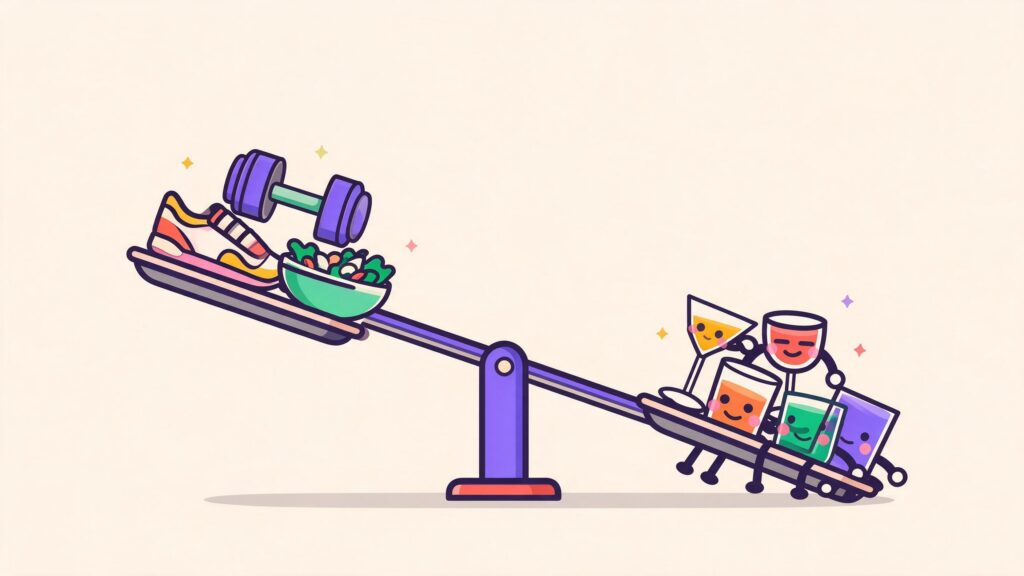
The health offset. I ran 20 miles a week, so surely that canceled out the bottle of wine. I ate salads for lunch, so the evening cocktails didn’t count. I treated health like a ledger where exercise and nutrition were credits that offset the alcohol debits. Spoiler: biology doesn’t work like accounting.
The productivity proof. I was good at my job. Creative, reliable, promoted twice in three years. How could someone with a drinking problem be this productive? The answer, of course, is that high-functioning isn’t a type of drinking — it’s a stage of drinking. And stages don’t last forever.
The Wake-Up Calls I Ignored
The warning signs were there. I just labeled them as something else.
The morning anxiety that I attributed to “being a naturally anxious person.” The 3 AM wake-ups that I blamed on stress. The 15 pounds I’d gained over three years that I chalked up to “getting older” and a “slowing metabolism.” The blood test that showed elevated liver enzymes — my doctor said to “cut back on alcohol,” and I told myself I had. I cut back from five drinks to four and called it progress.
The sleep tracker on my wrist told a story I didn’t want to read. My deep sleep was consistently abysmal. My resting heart rate was 10–15 beats higher on nights I drank. My heart rate variability — a key indicator of stress and recovery — was terrible. I had data literally strapped to my body telling me that alcohol was hurting me, and I still found ways to dismiss it.
This is the dark magic of the high-functioning drinker: the ability to look at clear evidence and explain it away. We’re not lying to others. We’re lying to ourselves, and we’re very, very good at it.
What Tracking Revealed That Denial Hid
Here’s where Soberya entered the picture. A friend recommended it — not as an intervention, but casually, the way you’d recommend a calorie tracker or a budgeting app. “It’s interesting to see the patterns,” she said.
She was right. It was interesting. And deeply uncomfortable.
The app doesn’t judge you. It doesn’t tell you you’re drinking too much. It just shows you the data. And the data showed me things my denial had been actively suppressing:
- I hadn’t had a single alcohol-free day in over four months. Not one.
- My “moderate” drinking averaged 28 drinks per week — four per day — which put me in the top 10% of drinkers nationally.
- My drinking had been slowly, steadily increasing for two years. Each year, the weekly average was higher than the last.
- The nights I told myself I’d “just have one” almost always ended at three or more.
Seeing it laid out like that — not as a feeling, not as a vague concern, but as hard numbers on a screen — was the first crack in my denial. You can argue with a feeling. You can’t argue with a spreadsheet.
The Slow, Invisible Deterioration
The danger of high-functioning drinking isn’t a dramatic crash. It’s erosion.
Every morning a little more tired. Every year a little more weight. Every blood test a little worse. Every relationship a little more distant — because you’re present but not really present, there but chemically buffered. The changes are too slow to notice in real time. It’s only when you look back across years that you see the slope.
I was becoming a worse version of myself — less patient, less energetic, less curious, less alive — and I had no idea it was happening. Because it wasn’t happening on a Tuesday. It was happening across a thousand Tuesdays.

How to Assess Yourself Honestly
If any of this sounds familiar, here are some questions worth asking yourself. Not the ones from a clinical screening — I’d passed those every time. Real questions:
- When was the last time you went a full week without drinking? Not “cutting back” — zero drinks for seven consecutive days.
- Do you negotiate with yourself about drinking? “I’ll just have two tonight, and then I won’t drink tomorrow” — and how often does the “won’t drink tomorrow” part actually hold?
- If you track your drinks honestly for 30 days, what do you think the number will be? Now double it. Is that closer to reality?
- Does the idea of tracking your drinking make you uncomfortable? If so, ask yourself why.
The most honest assessment I ever did wasn’t a questionnaire. It was opening Soberya and logging every drink for 30 days. The data did the assessment for me.
From High-Functioning to Actually Thriving
I’m not going to tell you I quit drinking entirely. That’s not my story, and it doesn’t have to be yours. But I did change my relationship with alcohol fundamentally.
I took 30 days off to reset. I tracked everything. I paid attention to how I felt — the good (better sleep, more energy, clearer skin) and the hard (social discomfort, boredom, cravings). After 30 days, I reintroduced alcohol with intention instead of default. Now I drink maybe 2–4 drinks per week, almost entirely on weekends, and only when I genuinely want to.
The difference between high-functioning and actually thriving isn’t always abstinence. Sometimes it’s just honesty. The willingness to look at the data, stop negotiating with yourself, and admit that “functioning” is a pretty low bar for a life.
If you see yourself in any of this, try a 30-day experiment. Track every drink. No rules, no judgment — just data. Let Soberya show you what denial has been hiding. You might be functioning just fine. But you might also discover you could be doing a lot better than fine.