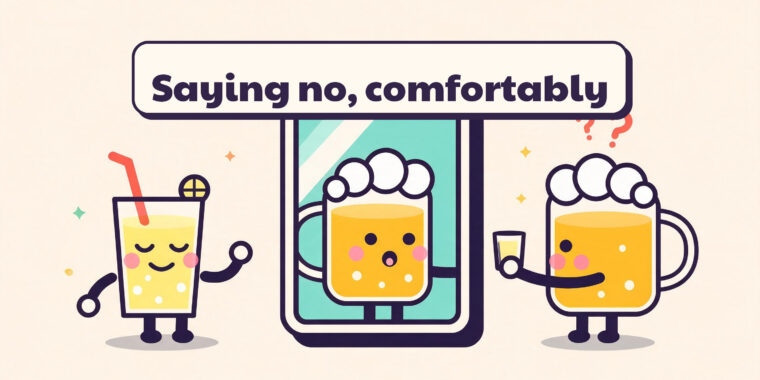
There’s a special kind of social interrogation that happens when you say “I’m not drinking tonight.”
The questions come fast:
“Why not?” “Are you sick?” “Are you pregnant?” (If you’re a woman, this one arrives in approximately 0.4 seconds.) “Come on, just one.” “You’re no fun.” “Is everything okay?”
And my personal favorite, delivered with performative concern: “Are you… doing that sober thing?”
You’re not an alcoholic. You just don’t want a drink right now. But somehow, you’re the one being cross-examined.
Welcome to the weirdest social norm in modern life: drinking is the default, and not drinking requires an explanation.
Why People Actually Care (It’s Not About You)
Before we get to the solutions, let’s understand the psychology. Because once you see it, it becomes almost funny.
When you decline a drink, you’re not making a statement about yourself. You’re holding up a mirror. And what the other person sees is: “Wait, if they’re not drinking… should I be drinking? Am I drinking too much? Does my drinking look bad now?”
Your one “no thanks” triggers their entire internal monologue about their own habits. That’s why some people get weirdly pushy. They’re not trying to ruin your night. They’re trying to make their own drinking feel normal again.
It’s not about you. It’s about their discomfort. Once you internalize that, the pressure loses about 80% of its power.

The Scripts: Exactly What to Say
The key is having a pre-loaded response. If you improvise, you’ll either over-explain (which invites more questions) or get defensive (which makes it weird). Pick one of these and practice it:
The Casual Deflect
“Nah, I’m good with this for now.” (Raise your glass of water/soda/mocktail.)
Works because: it’s boring. Boring answers don’t invite follow-up questions.
The Honest Approach
“I’m just trying to drink a bit less these days. Sleeping better, feeling better, you know?”
Works because: it’s relatable. Most people have thought about cutting back.
The Goal Card
“I’m doing a 30-day thing. Day 14, can’t break the streak now!”
Works because: people respect streaks. If you mention tracking your streak on an app, they usually back off — nobody wants to be the person who broke someone’s streak.
The Health Pivot
“Got an early gym session / run / meeting tomorrow. Gotta be sharp.”
Works because: it reframes not-drinking as a choice in service of something else, not as deprivation.
The Joke
“I’m way more fun sober. Trust me, you don’t want to meet drunk me.”
Works because: humor disarms. It also makes it clear you’re not judging them.
The Blame Shift
“Doctor’s orders. Well, my doctor didn’t exactly say it, but I’m pretty sure she’d be proud.”
Works because: blaming an external authority removes you from the equation entirely.
What NOT to Do
Some approaches backfire:
- ❌ Over-explaining: “Well, you see, I read this study about alcohol and REM sleep, and actually ethanol metabolizes into acetaldehyde which…” — you’ve lost them. And now you sound like you’re lecturing.
- ❌ Getting preachy: “I just don’t think alcohol is good for anyone, you know?” — congratulations, you’ve made everyone uncomfortable.
- ❌ Lying unnecessarily: “I’m on antibiotics” works once or twice, but your friends will notice if you’ve been on antibiotics for 18 months.
The Real Move: Own It
Here’s the advanced technique. Instead of deflecting, just be direct and unbothered:
“Not drinking tonight.”
Full stop. No explanation. Said with the same casual energy as “I’ll have the fish.”
The first time you do this, it feels terrifying. The tenth time, it feels powerful. You realize that most people just go “okay cool” and move on. The ones who don’t? That’s useful information about them.

What About When You’re Actually Trying to Cut Back?
If you’re in the middle of cutting back — tracking your units, trying to stay under a weekly limit — the social pressure gets harder. You’re not just declining one drink. You’re declining drink number four when you’ve already had three and your weekly unit budget is maxed out.
This is where having a tracker helps. When you can look at Soberya and see “I’m at 13.2 units this week, my limit is 14,” it turns a vague feeling of “I should probably stop” into a concrete data point. Much harder to argue with a number than with a feeling.
Plus, the streak feature gives you something to protect. When you’ve logged 12 days of staying under your limit, breaking it for one more drink feels like a bad trade. Data creates accountability. Accountability creates better decisions.
The Bottom Line
You don’t owe anyone an explanation for what’s in your glass. But having a few smooth responses in your back pocket makes the whole thing easier.
And if you want help sticking to your limits when the peer pressure peaks at 11pm on a Saturday, Soberya keeps your goals visible when your willpower isn’t.
Now go order that sparkling water with lime. It looks like a gin and tonic anyway.


